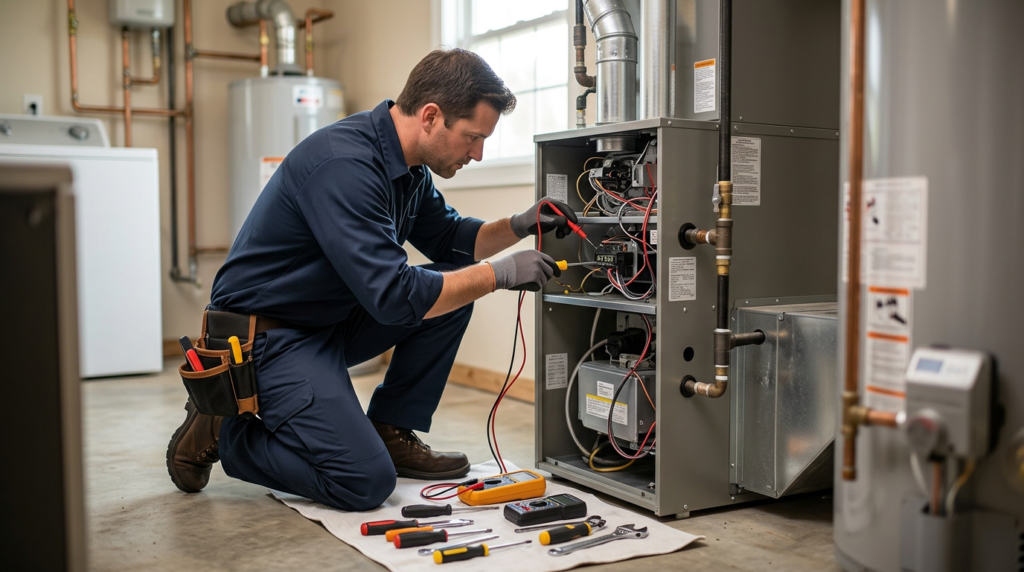
Quick answer: Most furnace problems in Bishop, GA can be repaired if the heat exchanger is sound, the issue is limited to one failed component (like an igniter, flame sensor, capacitor, or control), and the system isn’t stuck in a repeat-breakdown cycle. Replacement is the better call when a safety test flags the heat exchanger, repairs are piling up, or comfort and reliability don’t improve after a proper, test-based diagnosis.
Quick Signs It’s Likely a Repair
If your furnace ran fine recently and suddenly won’t start, a repair is usually the first move. Common culprits include a dirty flame sensor, a failed hot-surface igniter, a tripped rollout switch, a clogged condensate drain (on many high-efficiency units), or a weak capacitor on the blower. These problems can stop heat entirely but don’t automatically mean the furnace is “done,” especially if the heat exchanger checks out.
Watch for patterns that point to a straightforward fix: the thermostat calls for heat but the furnace cycles and quits; the blower runs with no heat; you hear clicking without ignition; or the unit starts, warms briefly, then shuts off. A technician can confirm basics like gas supply, intake/exhaust venting, filter restriction, and proper flame signal. If you’re searching for furnace repair Bishop GA, ask for a diagnostic that explains what failed, what test confirmed it, and what would reduce the chance it happens again.
Bishop-area homes often have either natural gas/propane furnaces or heat pumps with electric backup (and sometimes dual-fuel setups). That matters because a “no heat” call could be a gas ignition issue, a heat pump defrost/aux-heat control issue, or simply a thermostat staging problem. In our humid Georgia winters, condensate and drain routing can also cause nuisance shutdowns on high-efficiency furnaces if a trap or drain line backs up.
A Simple Repair vs Replace Checklist
Replace if the heat exchanger is cracked or fails a combustion/CO safety check, or if the unit has a condition the manufacturer treats as unsafe to operate.
Consider replacement if (a) the quoted repair is roughly 30–50% of the cost of a new system, (b) you’ve had 2+ major repairs in the last 12 months, or (c) parts are obsolete or repeatedly failing due to age-related wear.
Repair if the heat exchanger and venting are verified safe and the problem is a single, well-defined component failure (ignition part, sensor, capacitor, inducer motor, control board) with no signs of broader system issues like chronic overheating, water damage, or severe corrosion.
How a Good Diagnosis Separates the Two
A solid diagnosis should include safety and combustion checks appropriate to your equipment type, plus airflow and control verification. You should come away knowing the specific failed part, what evidence supports it, and what the next likely failure risk is if you only replace the obvious part.
Ask how the technician verified the problem. For example, flame-sensor performance can be verified by measuring the microamp signal against the manufacturer’s spec; pressure-switch issues are usually confirmed by checking venting/condensate restrictions and verifying the switch operation per the unit’s sequence of operation; blower issues are commonly confirmed by checking capacitor value against its rating and verifying motor operation within manufacturer limits. These test-based checks reduce guesswork and help you decide between repair and replacement with less risk.
Local context helps troubleshooting: if your home uses propane, fuel pressure and regulator issues can mimic ignition failures; if you have a heat pump with auxiliary heat, a comfort complaint may be tied to staging, defrost behavior, or a failed heat strip rather than the “furnace” itself. On high-efficiency gas furnaces, condensate management (trap, drain slope, pump, and vent termination) is a frequent source of intermittent lockouts during damp, cool weather.
What to ask your contractor: “What test confirmed the failure? Is the heat exchanger and venting verified safe? What are my repair options with part and labor scope spelled out? If you’re recommending replacement, what specific problem will a new system solve that a repair won’t, and what assumptions are you making about sizing, airflow, and duct condition?”